
Table of Contents
When designing or renovating a kitchen, bathroom, or any other space that requires cabinetry in 2026, the types of cabinet features you choose can dramatically impact both the functionality and aesthetic of the room. Whether you're a homeowner embarking on a renovation or a contractor advising clients, understanding the different options — such as sliding drawers, open cabinets, and shelves — will help you make informed decisions tailored to your home and budget.
This guide goes further than a generic features list. Below, you'll find what ProBrothers clients in Media, Delaware County, and the Main Line actually request most often, what our installation team notices in the field, and real cost data specific to the Philadelphia metro market — not national averages.
1. Sliding Drawers: Convenience and Accessibility
Sliding drawers are a popular and highly practical feature, especially for kitchens and bathrooms in 2026. They provide easy access to items in the back of cabinets, making it simpler to organize and retrieve everything from pots and pans to cleaning supplies. They're especially useful for lower cabinets, where bending down to access items can be a hassle. Sliding drawers can be customized with dividers or organizers to make the most of available space, allowing for everything from utensil storage to full pull-out pantry shelving—an increasingly popular choice in 2026 home designs.
Pros of Sliding Drawers:
- Increased accessibility – No more reaching or digging around in deep cabinets.
- Better organization – Ideal for storing small items like spices, utensils, or cleaning products.
- Maximized space – Allows you to store more efficiently by using the depth of cabinets.
Cons of Sliding Drawers:
- Cost – Sliding drawers are more expensive than traditional shelves or doors due to the mechanisms involved and the materials needed.
Sliding drawers can range from $100 to $500 per drawer depending on the materials and the level of customization. The price will increase if you're opting for high-end materials or specialized features such as soft-close mechanisms, which are trending in 2026.
2. Open Cabinets Features: A Trendy, Accessible Option
Open cabinets have gained popularity in modern home designs for their minimalist, airy feel, and this trend continues into 2026. This style of cabinetry does not have doors or fronts, providing direct visibility and easy access to your items. Open shelves or cabinets are often used to display decorative items, cookware, or dishware in kitchens, while in bathrooms, they can hold towels or toiletries—a stylish yet practical choice for 2026 interiors.
Pros of Open Cabinets:
- Visual appeal – Open shelves allow for showcasing beautiful dishware, plants, or other decorative items.
- Easy access – No need to open a door or pull out a drawer; items are instantly visible and accessible.
- Spacious feel – Open cabinets make a room feel less cluttered and more open, which is particularly useful in smaller spaces.
Cons of Open Cabinets:
- Dust and dirt accumulation – Items on open shelves or in open cabinets are exposed to dust, grease, and moisture.
- Clutter can accumulate – Without doors to conceal items, open shelving can easily become cluttered if not regularly organized.
Open cabinets are generally less expensive to install than traditional closed cabinets, as they don't require doors or complex mechanisms. Prices will vary depending on the material and whether you're opting for custom-built open shelving. Typically, expect to pay $50 to $300 per shelf, with high-end finishes pushing the cost higher in 2026.
3. Shelves: Versatile and Practical
Shelves are one of the most versatile cabinetry features you can incorporate into your design. They can be installed in any room, offering functional storage for everything from books and plants to pantry items and bathroom essentials. Shelves can be either open or enclosed within cabinets, and their placement can vary based on your storage needs and design preferences—making them a staple in 2026 home renovations.
Pros of Shelves:
- Flexible storage – Shelves can hold a variety of items, from pantry goods to decorative objects.
- Customizable – You can adjust the number of shelves or their height to accommodate your specific needs.
- Affordable – Shelves are often one of the most cost-effective cabinet features available.
Cons of Shelves:
- Open shelves require regular maintenance – Like open cabinets, shelves are prone to dust and can become cluttered quickly if not kept organized.
The cost of shelves varies significantly depending on whether they are custom-built or pre-made, as well as the material used. Basic shelves can cost as little as $20 to $100 per unit for a simple, wooden shelf, while custom shelves or shelves made from premium materials (like glass or metal) can range from $150 to $500 per unit.
4. How Much of Each Cabinet Feature Do You Need?
The amount of sliding drawers, open cabinets, and shelves you incorporate into your design will depend on both your storage needs and your budget. Here are a few guidelines to help you balance functionality and cost:
- Sliding Drawers: If you cook often and need easy access to items like spices, utensils, or pots, consider adding sliding drawers to your kitchen design. For bathrooms, sliding drawers can be perfect for toiletries or cleaning supplies. However, because they are more expensive, you may want to prioritize these features in cabinets that will be used the most in 2026.
- Open Cabinets: Open shelving works well in spaces where you want to showcase items and create an airy, minimalist look. In kitchens, open cabinets can work well for frequently used items like plates and cups. However, if you don't want the added maintenance of keeping your items dust-free, you may want to limit the amount of open shelving.
- Shelves: Shelves are highly versatile and can be used in almost any area. They're an affordable option for adding storage in both kitchens and bathrooms. If your budget is limited, shelves are a great way to maximize space without breaking the bank.
5. Which Cabinet Features Are More Expensive?
As mentioned, sliding drawers tend to be the most expensive feature due to the additional materials and labor required for installation. Open cabinets, on the other hand, are typically the most budget-friendly option, as they don't require doors or complex mechanisms. Shelves fall somewhere in between, depending on their customization.
Cost Breakdown:
- Sliding Drawers: $100 to $500 per drawer
- Open Cabinets: $50 to $300 per shelf
- Shelves: $20 to $500 per unit (depending on customization and material)
Choosing the right combination of cabinet features for your space in 2026 requires balancing your needs for functionality, aesthetics, and budget. Sliding drawers offer exceptional accessibility but can be costly, while open cabinets and shelves are more affordable options that can still provide great storage and design flexibility.
6. Top 5 Cabinet Features ProBrothers Clients Actually Request
Generic feature lists tell you what exists. What follows is grounded in what Delaware County and Main Line PA homeowners actually choose when they sit down with our team — drawn from ProBrothers' project history across kitchens, bathrooms, home offices, and custom built-ins.
Soft-Close Hinges and Drawer Slides
In our experience, soft-close hardware is the single most frequently added upgrade on kitchen and bathroom cabinet projects. Clients initially ask about it for the quiet factor — nobody wants slamming cabinet doors in a busy household. But the real reason to specify it is longevity: soft-close mechanisms reduce frame stress significantly over the life of the cabinet, which matters especially in older Delaware County homes where humidity and temperature swings can stress wood joints. Cost reference: soft-close hardware upgrades run approximately $25–$75 per door or drawer at Delaware County installation rates.
Pull-Out Drawer Systems for Base Cabinets
Pull-out drawers in lower base cabinets are the most transformative functional upgrade for kitchens where the client cooks regularly. Rather than reaching past stacked pots into the back of a deep cabinet, every item is accessible from the front. We see this most commonly in kitchen renovation projects where clients specify pull-outs for pot storage, baking sheets, and pantry conversion areas. This is also where drawer weight capacity becomes critical — see the installer's note below.
Custom Drawer Inserts and Organizers
Especially popular in kitchen and home office projects, custom drawer inserts — dividers for utensils, compartments for small tools, knife blocks, or pen/notebook trays — allow homeowners to design the interior of their cabinets around how they actually live. Our Dark Blue Office project (Chester County area) is a good example: the client specified multiple small drawer compartments alongside large file storage, so the workspace stayed organized and professional-looking without appearing crowded.
Under-Cabinet Lighting
Under-cabinet lighting is requested on a significant share of our kitchen and bathroom vanity projects. It serves two purposes: functional task lighting on countertops, and ambient accent lighting that elevates the look of the space. In vanity projects we've done across Delaware County — including custom vanity builds where the client wanted makeup-ready lighting — LED strips under upper cabinets made a notable difference in the finished result.
Floor-to-Ceiling Custom Storage
For rooms where every inch of wall space matters — home offices, libraries, mudrooms, and laundry rooms — clients increasingly request floor-to-ceiling custom cabinetry rather than freestanding furniture. Our Blue Library project is the most complete example: a spare room transformed with a full wall of floor-to-ceiling bookshelves, a matching closet on the opposite wall, ceiling beams, and paneling throughout. The sliding ladder we built for the upper shelves is the kind of detail that only a custom-built solution can deliver.
7. Feature Add-On Costs in Delaware County — Per-Feature Breakdown
Most cost guides show total kitchen or bathroom renovation figures. What homeowners in Media, PA and surrounding Delaware County communities actually want to know is: how much does each specific feature add to the total? The table below breaks it down by feature, sourced from ProBrothers' project pricing in the Philadelphia metro market and cross-referenced with the ProBrothers 2026 kitchen cabinet cost guide.
| Feature | Unit | Material Cost Range | Notes |
|---|---|---|---|
| Soft-close hinges Most Requested | Per door/drawer | $25 – $75 | Longevity upgrade; reduces frame wear; recommended standard on custom builds |
| Pull-out drawer (base cabinet) | Per drawer | $100 – $500 | Price varies by weight capacity and slide mechanism; pantry-conversion drawers require heavy-duty slides |
| Custom drawer inserts / organizers | Per drawer | $50 – $300 | Knife blocks, utensil dividers, and pen/notebook trays; fully custom vs. modular pricing differs |
| Under-cabinet LED lighting | Per linear foot | $20 – $60 | Functional task lighting and ambient accent; often quoted separately from cabinetry |
| Pull-out spice rack / pantry unit | Per unit | $150 – $500 | High ROI in kitchens with limited counter space; common in Delaware County galley kitchen renovations |
| Lazy Susan (corner cabinet) | Per unit | $80 – $250 | Full-round vs. kidney-shape; full-round preferred for accessibility |
| Glass-front door panels | Per door | $100 – $400 | Clear, seeded, or frosted; requires interior lighting to show impact |
| Full custom built-in (e.g., floor-to-ceiling shelving) | Per project | $2,000 – $15,000+ | Highly scope-dependent; Blue Library project is an example of this tier |
| Sources: ProBrothers 2026 Kitchen Cabinet Cost Guide; Remodeling Magazine Cost vs. Value Report (Philadelphia metro). Contact ProBrothers for a project-specific quote at (484) 745-4097. | |||
8. From the Workshop: What Daniil Notices
Daniil Akulov
The feature conversations I have with clients are never just about which option looks best in a photo. The questions I hear most often are the ones where a homeowner has been burned before — a drawer that failed under a heavy pot, a cabinet door that started racking after two years, hardware that looked right in the showroom but felt flimsy to the touch. Here's what I've learned from actually installing cabinets in Delaware County homes for fifteen years.
"Most clients underestimate drawer weight capacity for a pantry-conversion cabinet. When we're converting a base cabinet into a full pull-out pantry, clients often imagine a standard drawer slide can handle canned goods, bulk dry goods, and cookware all in one unit. Standard slides are rated for 75–100 lbs. A fully loaded pantry pull-out can exceed 150 lbs easily. We specify heavy-duty undermount slides rated for 150–200 lbs minimum on any pantry-conversion drawer. The material cost difference is real, but a failed slide at full load is a safety issue — not just an inconvenience."
In older Delaware County homes — particularly those built in the 1950s through 1980s with plaster walls — soft-close hinges solve a secondary problem that clients don't anticipate: plaster doesn't absorb vibration the way drywall does. In a home with plaster-and-lath construction, repeated cabinet slamming eventually works loose the mounting screws in the cabinet face frame. We've done cabinet repairs on older homes where the hinges are literally pulling out of the frame because the previous installation didn't account for this. Soft-close hardware eliminates that impact entirely.
On open shelving: it's beautiful in photos, and I install it when clients want it. But in Delaware County kitchens — especially older homes where cooking happens seriously — the grease and humidity load is real. I typically recommend limiting open shelving to one accent area of the kitchen and using closed cabinets for primary storage. The clients who ignore this advice almost always come back wanting to close it up within two years.
One thing I've learned about hardware specifically: the finish has to survive the environment, not just look right at install. In bathrooms and kitchens with steam — especially in homes without great ventilation — we recommend brushed nickel or matte black over polished chrome, because polished finishes show water spots and start looking worn much faster. It's a small decision that people regret when they don't make it at the start.
9. ProBrothers Project Examples — Cabinet Features in Practice
The features above aren't theoretical. Here are two completed ProBrothers projects where cabinet feature selection shaped the entire outcome of the space.
ProBrothers Project — Kitchen Renovation
Two-Tone Kitchen Restoration — Media PA Area
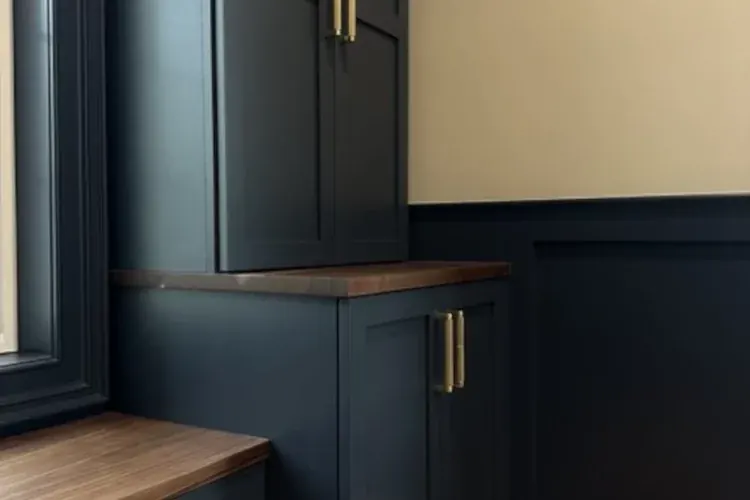
A client contacted ProBrothers wanting to transform her old kitchen into a place she'd actually want to spend time in. After the initial consultation, we demolished the existing kitchen, flooring, and appliances, and rebuilt from scratch. The client wanted the space to feel simple but distinctive — which led to a two-tone cabinet finish, a choice that requires careful planning at the design stage to ensure the upper and lower color tones complement rather than compete. The completed kitchen was a dramatic upgrade: custom-built cabinets with a premium two-tone finish, fully replacing the previous layout. This project illustrates how finish selection and cabinet-feature choices drive the character of the room far more than any single feature in isolation.
ProBrothers Project — Custom Built-In Cabinetry
Blue Library — Floor-to-Ceiling Custom Build
A book-loving client came to us wanting to transform a spare room into a home library. The requirement: floor-to-ceiling bookshelves spanning wall to wall, with a closet on the opposite side for personal storage, and ceiling beams to complete the room. Every cabinet was custom-made and finished in the shop before installation on site. To solve the reach problem at the top shelves, we built a sliding ladder into the bookcase — a feature that only works when the cabinet structure is engineered for it from the start. We also panel-walled the room and added trim to make everything look continuous. The result: a room that went from empty to architecturally finished.
Frequently Asked Questions About Modern Cabinet Features
What are the most functional cabinet features for a 2026 kitchen remodel?
The most functional features for 2026 include sliding pull-out drawers, built-in organizers, and soft-close mechanisms. Sliding drawers are particularly essential for lower cabinets in kitchens and bathrooms, as they eliminate the need to reach into deep, dark corners. These features significantly improve accessibility and organization, making them a top priority for homeowners in areas like Media and West Chester, PA.
Are sliding cabinet drawers more expensive than traditional shelves?
Yes, sliding drawers generally cost more than standard fixed shelves due to the precision hardware and labor required for installation. In 2026, you can expect to pay between $100 and $500 per drawer depending on the material and weight capacity. However, many homeowners find the long-term benefit of increased storage efficiency and reduced physical strain well worth the initial investment. For pantry-conversion drawers specifically, heavy-duty slides (rated 150–200 lbs) are recommended — standard slides are not adequate for fully loaded pantry pulls.
Should I choose open shelving or closed cabinets for my kitchen?
The choice depends on your lifestyle. Open shelving creates a trendy, airy feel and is perfect for displaying decorative dishware or frequently used items. However, closed cabinets are better for hiding clutter and protecting items from the dust and grease common in Pennsylvania kitchens. Many ProBrothers clients opt for a hybrid approach — using closed cabinets for bulk storage and open shelves for a minimalist, modern aesthetic. In older Delaware County homes with active cooking, we typically recommend limiting open shelving to one accent area.
What is the benefit of adding soft-close hinges to cabinets?
Soft-close hinges and drawer slides prevent doors from slamming, which reduces wear and tear on the cabinet frames and extends the life of your cabinetry. This feature is particularly important in older Delaware County homes with plaster-and-lath construction, where cabinet slamming gradually works loose the hinge mounting screws. Soft-close hardware costs approximately $25–$75 per door or drawer and is one of the highest-value upgrades for long-term cabinet performance.
How much does it cost to add custom storage features to existing cabinets?
The cost to add custom features like pull-out spice racks or heavy-duty pot drawers typically ranges from $150 to $500 per unit. Investing in these specialized storage solutions during a renovation can significantly increase your home's resale value, especially in competitive markets like Kennett Square and Malvern, where buyers look for highly organized, chef-ready kitchens. According to the Remodeling Magazine Cost vs. Value Report, kitchen upgrades — including custom storage features — consistently rank among the highest-ROI investments homeowners can make before listing.
Are open cabinets harder to maintain than closed ones?
Yes, open cabinets require more regular maintenance because items are exposed to the air. In Delaware County kitchens, this means dust and cooking oils can accumulate on the shelves and dishes. If you prefer a low-maintenance kitchen, limit open shelving to a few accent areas and use closed cabinetry for primary storage needs.
What hardware finish holds up best in a Delaware County kitchen or bathroom?
In bathrooms and kitchens with steam — especially older homes without great ventilation — brushed nickel or matte black finishes outperform polished chrome over time. Polished finishes show water spots more readily and look worn faster. The finish decision is small at install time but one that clients frequently revisit when they don't make it deliberately at the start.
Ready to Plan Your Cabinet Project?
ProBrothers helps homeowners throughout Media, PA and Delaware County design and install custom cabinetry with the features that matter most. From sliding drawers to floor-to-ceiling built-ins, our team delivers quality craftsmanship on every project. Call (484) 745-4097 or contact us online to schedule a free consultation.