Table of Contents
I've been doing remodeling and general contracting work in Delaware County for 15 years, and I still get homeowners calling me in November asking if we can "just squeeze in" a basement egress window before the ground freezes, or a full trim replacement before company arrives for the holidays. Some years we can. A lot of years we can't, and I hate telling a Media homeowner in November that the job they wanted done by Thanksgiving needed to start in September.
Southeastern Pennsylvania has a specific fall pattern that a lot of generic "fall home checklist" articles miss entirely because they're written for a national audience, not for Delaware County. Our first hard frost typically lands somewhere in the second half of October, sometimes earlier in low-lying areas like parts of Glen Mills or along the creek valleys near Wallingford and Swarthmore. That's the hard deadline for anything involving exterior caulk, sealant, or paint, because most exterior-grade sealants need daytime temperatures above 40 to 50 degrees Fahrenheit to cure properly, and a lot of them want more like 50 to 60. Once we're consistently below that, you're not sealing your house, you're just gluing a bead of caulk to the outside of it that will crack out by spring.
Then there's the leaf drop itself. Delaware County has a heavy tree canopy, mature oaks, maples, and sycamores in almost every established neighborhood from Media to Newtown Square to West Chester, and the leaf drop here runs later and heavier than a lot of the generic checklist content assumes. Most of it comes down in a two-to-three-week window from mid-October through early November, which means if you clean your gutters in early September thinking you're ahead of it, you'll likely need a second pass in November anyway. I tell clients to think of gutter cleaning as a two-round job in this area, not a one-and-done task, unless you've got gutter guards installed.
And then there's the part that has nothing to do with weather and everything to do with how contractor calendars actually fill up. Every general contractor and remodeling crew in this market gets a wave of "let's get this done before the holidays" calls starting around Labor Day. By the third week of September, our schedule for anything requiring more than a day or two of work is largely locked through the end of the year. That's not a sales pitch, it's just how the math works when you've got a finite number of crews and a finite number of daylight-hour workdays left before winter.
Part 1: The Non-Negotiable Maintenance Checklist
These aren't remodeling projects. They're maintenance, and skipping them costs you more in February than doing them in September ever will.
Gutters and Downspouts
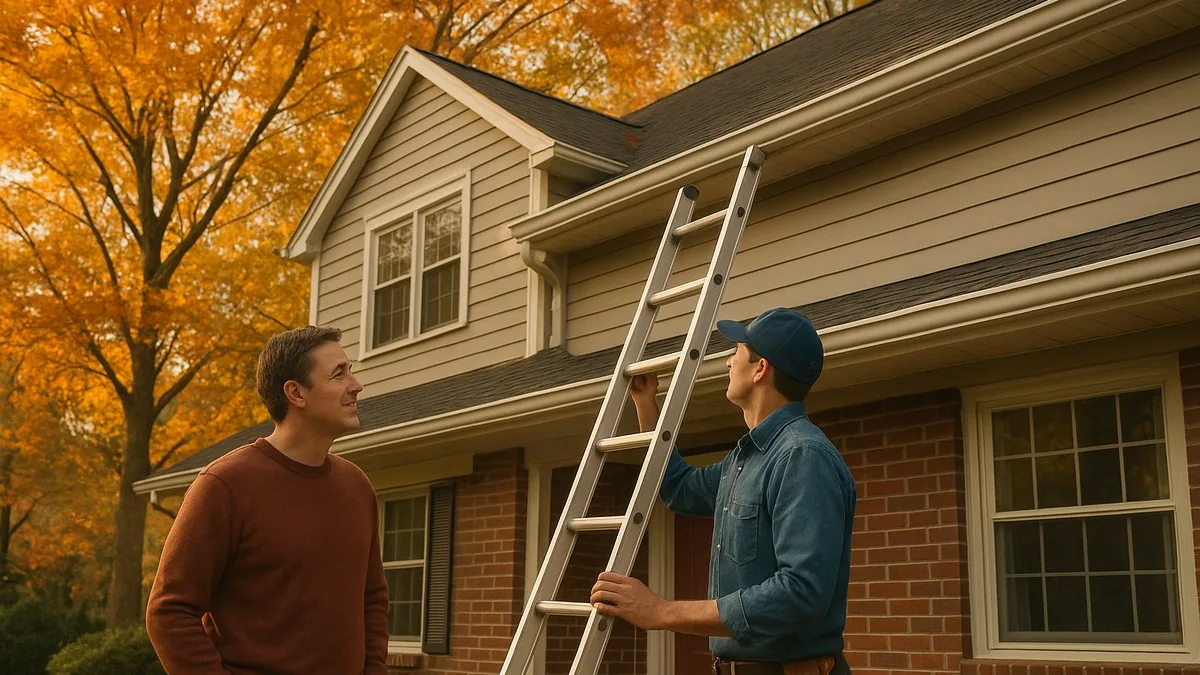
Clean gutters, check for sagging sections or pulled fasteners, and confirm downspouts are draining at least 4 to 6 feet away from your foundation, not just dumping water at the base of the house. In Delaware County's clay-heavy soil, water that pools near a foundation doesn't drain the way it would in sandier soil further south, and that's a direct contributor to the basement moisture issues I see constantly on remodel walkthroughs in older homes around Media and Swarthmore.
If your gutters back up regularly because of the tree canopy in your neighborhood, this is the year to look at gutter guards. They're not maintenance-free, but they cut the frequency of full cleanings roughly in half in the heavy-leaf neighborhoods I work in most.
When to do it: First pass by mid-September, second pass in early-to-mid November after most of the leaf drop is done. Don't wait for a single "final" cleaning in December; by then ice can already be forming in clogged sections, and cleaning frozen gutters is both dangerous and mostly pointless.
HVAC System Service
Get your furnace or heat pump serviced before you need it, not during the first cold snap when every HVAC company in the county has a two-week backlog. A basic fall service, filter change, burner or coil inspection, thermostat check, carbon monoxide detector test if you have gas heat, catches small problems while they're a scheduled repair instead of a Saturday-night emergency call in January.
I'm a general contractor, not an HVAC technician, but I've been in enough Delaware County basements and mechanical rooms over 15 years to have opinions on this: homes built before the 1980s in this area very commonly have ductwork that was never properly sealed at the joints, which means your furnace is working harder than it needs to. If you're doing any remodeling work that opens up walls or ceilings anyway, that's the cheapest possible time to have ductwork sealed or insulated, because the access is already there.
Exterior Caulk, Trim, and Weatherproofing
Walk the exterior of your house and check the caulk lines around window and door trim, where trim meets siding, and anywhere two dissimilar materials meet. Cracked or missing caulk is one of the most common sources of winter air infiltration and, worse, of water intrusion that you won't notice until spring when you find rot in a sill or trim board. The EPA's home weatherization guidance is a solid general reference for sealing priorities if you want the national framework, but the PA-specific detail that matters here is timing: you genuinely need warmer weather for most exterior sealants to cure and bond correctly, which is why this has to happen in September or early October, not whenever you get around to it in November.
While you're out there, check your exterior trim boards for soft spots, especially wood trim around window and door openings, fascia boards, and anywhere paint has failed and exposed bare wood. Trim replacement is a relatively small job compared to what happens if you leave it and that rot spreads into the framing behind it.
Windows and Doors
Check weatherstripping around all exterior doors and operable windows. If you can feel a draft with your hand held near the frame on a breezy day, that's lost heating dollars all winter and a comfort problem you'll be annoyed about by December. Weatherstripping replacement is a cheap DIY fix in most cases.
But if what you're actually finding is failed seals on double-pane windows, rotted window sills, or windows that are original to a pre-1970s Delaware County home and were never properly weatherized, that's a bigger conversation, and it's one you want to have in September, not November. More on evaluating whether it's time to replace vs. repair here.
Roof and Attic
A visual roof check from the ground (or have your contractor do it while they're up there for gutters) for missing, curling, or lifted shingles, and a look in the attic for any daylight coming through, water staining, or insufficient insulation. Attic insulation is one of the highest-return, lowest-glamour projects a homeowner can do before winter, and it's rarely mentioned in generic checklists because it's not visually exciting. It should be near the top of your list anyway.
Foundation and Exterior Grading
Check that soil grading around your foundation still slopes away from the house, and look for any new cracks in foundation walls or the driveway that might need attention before freeze-thaw cycles make small cracks bigger. This is a five-minute walk-around that a lot of homeowners skip and a lot of contractors, myself included, wish more people did before winter.
From the Workshop: What I Actually See Every October
Every fall, without fail, I get calls that follow the same pattern. A homeowner in Media or Newtown Square notices something, a soft spot on a window sill, water staining in a basement corner, a gutter that's been sagging all summer, and decides to deal with it "before winter." The problem is that "before winter" by the time they call in mid-October leaves almost no runway.
Here's the thing that doesn't make it into most fall checklists: exterior work has a hard weather ceiling in this region, and interior work has a soft scheduling ceiling. If you want exterior trim replaced, siding repaired, or a window swapped, and the forecast is showing a string of nights below freezing, that job either gets delayed to spring or gets done under conditions that compromise the result. I'd rather tell a client honestly that we're pushing an exterior job to April than do it badly in December to hit an arbitrary deadline.
Interior work, basements, additions, kitchen and bath remodels, doesn't have that same hard weather stop, but it has a scheduling stop that's just as real. I had a homeowner in Wallingford call me the second week of October last year wanting a full basement finish done before Christmas. The scope was reasonable, roughly 900 square feet with a half bath, and on paper it was a project we could do in about 8 to 9 weeks of active construction. The problem wasn't the work, it was that permitting through the township alone typically runs 2 to 4 weeks depending on scope, and we simply didn't have an open crew slot until January because everyone who called in August and September had already claimed the fall openings. That project started in January and finished in March. Had she called in August, it would have been done by the holidays like she wanted.
That's the pattern I want Delaware County homeowners to understand: the work itself isn't usually what runs long in the fall. It's the queue.
Part 2: Remodeling Projects Worth Starting Now, Before the Fall Rush
If you've got a remodeling project on your list for this year or you were planning to "get to it eventually," fall is the moment to decide, not procrastinate on, because contractor calendars fill from the back of summer forward.
Basement Finishing (Best Fit for a Fall Start)
Basements are interior work, which means weather isn't the constraint, scheduling is. A basement remodel that includes a bathroom typically runs 8 to 12 weeks from permit to final walkthrough, which means a project started in September has a realistic shot at being done, or close to done, before the holidays. Start in November instead, and you're likely finishing in the new year. For a full breakdown of what happens in each of those weeks, see our week-by-week basement remodel timeline for Media, PA, or our basement finishing services for scope and pricing.
Basements are also a smart fall project for a less obvious reason: they're the part of the house most exposed to seasonal moisture shifts. Starting a basement finish in fall, after you've addressed foundation grading and gutter drainage from Part 1 above, means you're building on top of a system that's already had its water-management issues addressed.
Window Replacement (Time-Sensitive, Not Weather-Locked)
Window replacement can technically happen in colder weather, but material lead times are the real constraint. Custom or specialty window orders can run 4 to 8 weeks depending on the manufacturer and style, which means an early fall order gets you installed windows before the coldest stretch of winter. If you've been putting off replacing those original single-pane or failed-seal windows we talked about in Part 1, September is the month to get the order placed. Our full window and door services page covers styles, costs, and what we check in older Delaware County homes before we order.
Trim and Millwork Projects
Interior trim work, crown molding, wainscoting, casing upgrades, is entirely weather-independent and one of the more schedule-friendly projects to slot into a fall calendar. If you've got a living room, dining room, or entryway you've wanted upgraded before hosting the holidays, this is a realistic fall project even started in October, provided your contractor has room on the calendar.
Additions and Larger Structural Projects
Home additions are the one category where I tell homeowners honestly: if you haven't already started the design and permitting process by late summer, you are not getting exterior structural work done before winter weather makes it impractical. Additions in Delaware County typically need $60,000 to $250,000+ in budget depending on scope and a permitting and design runway that alone can take 4 to 8 weeks before a shovel goes in the ground, per township.
Kitchen and Bath Remodels
These are almost entirely interior and weather-independent, which makes them a genuinely good fall project, but they're also the most in-demand project type going into the holiday season. A typical kitchen remodel runs 6 to 10 weeks depending on scope and cabinet lead times, and cabinet orders alone can take 4 to 8 weeks. If a kitchen or bath remodel is on your radar for this year, the cabinet order needs to go in now, not after Thanksgiving. For a real phase-by-phase breakdown of what those 6 to 10 weeks actually look like, see our kitchen remodel timeline for Media, PA, or our kitchen remodeling services for detail.
Case Study: A Springfield Homeowner Who Called at the Right Time
A homeowner in Springfield, PA called us the first week of September wanting two things done before winter: a full gutter and downspout overhaul (the existing system was undersized for the roof and had been overflowing at one corner for two seasons, contributing to a damp patch on an interior basement wall), and a basement finish, roughly 750 square feet, that had been on her list for two years. Budget for the combined project came in around $58,000, split between the exterior drainage correction (about $6,500) and the basement finish itself (about $51,500 for framing, electrical, a half bath, LVP flooring, and trim).
Because she called in early September, we sequenced the gutter and drainage work first, in mid-September, while weather was still cooperative for the exterior work and while it let the basement framing start on a foundation wall that wasn't actively taking on water from an overflowing gutter above it. The basement portion started the last week of September and wrapped in the second week of December, right at the edge of her original hope for "done before the holidays." Had she called in mid-October instead of early September, the honest answer would have been a January start for the basement, because both our schedule and the exterior drainage window would have already closed.
A Realistic Fall Timeline for Delaware County Homeowners
| Timeframe | What to Prioritize |
|---|---|
| Late August to early September | Schedule HVAC service; get on contractor calendars for any remodeling project; order custom windows or cabinets if planning fall installs |
| Early-to-mid September | First gutter cleaning; exterior caulk and trim inspection/repair while weather allows sealant to cure; foundation grading check |
| Mid-to-late September | Start any interior remodeling projects (basements, kitchens, baths, trim work) to hit a holiday completion target |
| October | Second gutter cleaning after peak leaf drop; final exterior sealing before temperatures drop below curing thresholds; roof and attic inspection |
| November | Interior finish work continues regardless of weather; exterior work should already be wrapped up; confirm HVAC is performing well under actual cold-weather load |
| December and beyond | New remodeling inquiries at this point are realistically spring/early-year starts, not before-the-holidays starts |
Permits and Township Timing in Delaware County
If any fall project you're planning requires a permit, bathroom additions, egress windows, structural changes, electrical or plumbing work, factor in Delaware County's township-by-township variation in permit processing. Some smaller municipalities turn permits around in about a week; busier townships can run 3 to 4 weeks, longer if the scope triggers a plan review. This is administered under the Pennsylvania Uniform Construction Code, with enforcement and inspection scheduling handled locally by each township. Submit permit applications as early as possible in the fall process, ideally alongside your initial contractor consultation.
If you want a broader look at permitting and planning across project types, our 2026 home remodeling guide has a full section on this.
A Note on Hiring a Contractor for Fall Work
If you're vetting a contractor for a fall project, a legitimate PA contractor should hold current registration under the Home Improvement Consumer Protection Act (HICPA) and carry proper insurance, and should be willing to give you a written schedule, not a verbal "we'll get to it." The National Association of the Remodeling Industry publishes general guidance on vetting remodeling contractors if you want a broader reference point.
Beyond credentials, ask specifically about fall scheduling capacity: how many active projects the crew has running through December, whether your project's start date is confirmed in writing, and what happens if a permit delay pushes your timeline.
Frequently Asked Questions
When should I start fall home prep in Delaware County, PA?
Start by late August or the first week of September for anything weather-sensitive (exterior caulking, gutter guards, HVAC service) and no later than mid-September if you want a remodeling project like a basement finish or kitchen remodel completed before the holidays. Contractor calendars in this market are largely booked for the season by late September.
What's the single most important fall maintenance task for older Delaware County homes?
Gutters and drainage, specifically confirming that downspouts move water at least 4 to 6 feet from the foundation. Older homes in this area, especially in clay-soil neighborhoods around Media and Swarthmore, are prone to basement moisture issues that trace directly back to poor exterior drainage.
Can I still get exterior caulking or trim work done in November in PA?
Technically yes, but most exterior sealants need daytime temperatures in the 50 to 60 degree range to cure properly, and southeastern Pennsylvania is often below that consistently by mid-to-late November. Work done outside that window may look fine initially but fail faster than work done in September or early October.
How far in advance should I book a contractor for a fall basement remodel?
Ideally by early September for a project you want finished by the holidays. A mid-size basement finish with a bathroom runs 8 to 12 weeks from permit to walkthrough, and permit processing alone can take 2 to 4 weeks depending on the township.
Do I need a permit for basic fall maintenance like gutter cleaning or caulking?
No. Routine maintenance, gutter cleaning, caulk touch-ups, weatherstripping replacement, does not require a permit. Permits come into play for structural changes, new plumbing or electrical work, egress windows, additions, or anything covered under the Pennsylvania Uniform Construction Code.
Is it too late to replace windows before winter if I order them in October?
It depends on the manufacturer and style. Custom or specialty windows can have 4 to 8 week lead times, which means an October order might not arrive and get installed until close to or after the first hard freeze. If you know you want new windows this year, ordering in September gives you the most buffer.
What fall remodeling projects are least affected by cold weather?
Interior work, basements, kitchens, bathrooms, and trim/millwork projects, is largely weather-independent and can continue through the winter once permits are in hand. Exterior work like siding, caulking, roofing, and painting is the category genuinely constrained by falling temperatures.
From the Workshop: The Queue, Not the Work, Is the Bottleneck
Every fall the same lesson repeats on our jobs: the actual construction rarely runs long once it starts. What runs long is waiting for an open crew slot, because everyone in Delaware County wants their project "done before the holidays" at the same time. That's why the honest advice, call by September, isn't a sales tactic. It's the difference between a Christmas-ready kitchen and a January start.
Ready to Get Ahead of the Fall Rush?
ProBrothers serves Media, Newtown Square, Haverford, Springfield, West Chester, and surrounding Delaware County communities. Free quote within one business day. 5.0 rating · 15+ years · 135+ projects. ProBrothers is a licensed and insured Pennsylvania general contractor — PA HIC# 195591.